
Pinkston’s Site User Safety Bulletin – June 2025
 As we approach our busy summer season, we are keen to update you all on some of the changes across our site. As always, if you have any concerns or suggestions about any of the following topics, please do feel free to get in touch or pop by the office to say hello.
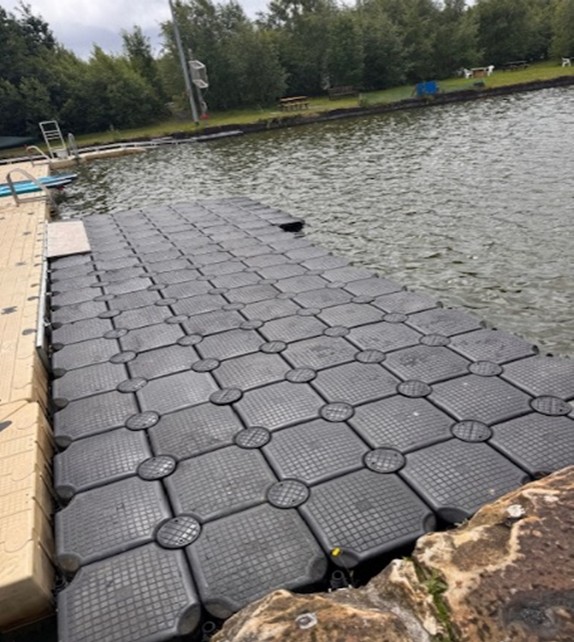
Pontoon beach – There have been some significant changes to our accessible pontoon on pitch 1. Our aim is to create a ‘beach’ effect with sloping pontoon blocks to allow for easier launching and landing of canoes and kayaks. As the accessible pontoon sits quite high out the water, this posed problems for launching rafted canoes during our sessions for people with additional support needs. The ‘beach’ should hopefully combat these problems by allowing more people to access the water in a safer and more controlled way.
The beach is not quite finished yet, we are hoping this will be completed in the next few weeks. In the meantime, it is worth having a look at the current set up and reviewing risk assessments for your organisation.
Carpark safety – A small reminder that the speed limit in the car park is 5mph.
BA floatation station – You may have noticed the black wheely bin outside our office. No, this is not for rubbish but is in fact a buoyancy aid testing station. This is available for everyone to use, if you need any help or support on how to test your buoyancy aid – stick your head in the office and we can arrange a time to help you out.
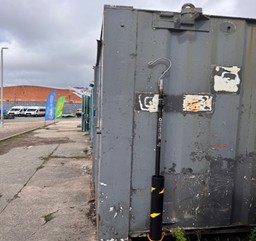
Safety hook – As there are changes to the pontoon on pitch 1, we now have a reach pole that could help in the very unfortunate event of someone/something being stuck underneath the pontoon. This is an extendable pole with a hook on the end that can reach the entire width of the accessible pontoon. This will be located on the side of the grey container (Monklands/DCKC) at the end of the run directly opposite the accessible pontoon. Please familiarize yourself with where this is so you know where to go in an emergency.
Is your Kayak white water ready?
Paddling white water is one of life’s greatest pleasures. For those that decide it is something they would like to enjoy, most of us put in a huge amount of effort into learning the skills required and reap the benefit of that effort. In addition to that hard work, it is worth spending a few minutes, and sadly possibly a few pounds, just making sure your kayak is as prepared as we are. In the 10 years since Pinkston opened, we have seen a few incidents that could have been prevented if kayaks had been better prepared, so here are some thoughts from the team and we are keen to hear anything from you folks about anything we’ve missed.
Firstly, is it a kayak suitable for white water? Sea kayaks are great in the right place, but on the river, they are generally pretty useless. That was probably obvious, but there are some old general-purpose kayaks out there that were once considered suitable for white water that, with the benefit of some unpleasant experiences, we would probably consider not so suitable nowadays. Keep those old Dancers, Europas and the like for flat water or decorations on the wall, the shape and cockpit size make them unsuitable for white water.
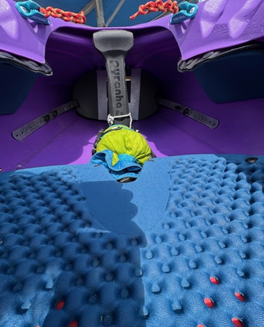
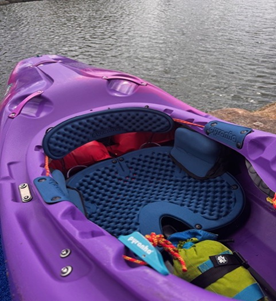
Secondly, is everything that is supposed to be fastened to your boat actually fastened to your boat? Sounds obvious, but we have seen more kayaks with seats, thigh grips or footrests not attached correctly than we would like to. Tighten those bolts and replace the missing ones so that the next dynamic move you go for doesn’t result in a seat or thigh grip malfunction and no transfer of power to the boat as anticipated. Once all those nuts and bolts are tight, make sure everything is adjusted correctly. Footrests in particular.
For those where the width can be adjusted (Dagger/Prijon), make sure it fills the space right out to the sides and for those with different sizes of pods (Pyranha), make sure you have the correct pod and foam plate fitted to fill the space. Failing to do so means the legs of the footrest come in at an angle and leave a space that feet can get trapped in. This is most likely to happen when you are trying to roll, and if you don’t make it, you are now stuck in an upside-down boat.
Lastly, fill that boat with air and it is considerably lighter than water. By that I mean fit bow (yes, bow) and stern air bags. An average river kayak has over 250 litres of volume. When that is full of water following a capsize, that is 250kg (a quarter of a tonne).
It is a neutral weight in the river, but it has huge momentum when it stops against a rock which can result in significant damage to the boat or to you if you find yourself between the boat and the rock. It is also a huge weight when your friend is trying to partially empty it before shoving to the bank or when you are emptying on the banks. See those air bags as insurance for either your boat, your friends back or your own back.
We hope this is helpful, and please let us know any thoughts you have on the subject.
Dougie and Niamh.